Parallels between salsa dancing and my professional life
Published at https://www.linkedin.com/feed/update/urn:li:linkedInArticle:7149949955753803776/
This past weekend I went salsa dancing after too many months away. I started to realize some of the parallels between salsa dancing and my professional life. I don't think salsa dancing is ever a trending topic on LinkedIn, but since I drafted some of this blog in my head while dancing, I decided to just publish it.
A little background on me
Salsa Dancing Background
Somehow, the "All Africans can dance" and "dance comes easy" genes skipped some of my family members, including me. I had to learn it. I started with swing, I liked salsa better, wasn't initially good at it (or most dances, honestly), but kept at it, performed for 6 years, and sometimes helped the instructors teach lessons. I would rate my skills as intermediate - not a pro and not a beginner.
I used to go salsa dancing 1-2 times a week. Now the goal is at least twice a month. On the dance floor, I'd rather be dancing than standing still. There is almost no such thing as a "bad dance" as long as we both had fun.
Professional Background
By day, I'm an Engineering Leader. Additionally, I'm a Board Trustee with The Visiola Foundation, an ambassador for SheTO, mentor with Big Brothers Big Sisters ... that summary is sufficient since if you want to know more, you can check out my LinkedIn profile. And my most important and favorite title/job is Mom.
Terminology
In case there are non-dancers reading this, here are a few terms:
"Salsa". The dance, not the sauce. Sometimes it specifically means the salsa dance (vs bachata, merengue, etc), sometimes it is used as a catch-all for all Latin dances. I'll mostly use it as a catch-all unless I need to be more specific.
"On 1", "On 2". There's a difference. Some dancers can do both, some can do only one.
"Salsa Lead". The person who leads the dance, deciding what the next steps are. Traditionally males but doesn't have to be. I'm putting Salsa in front of it so we don't confuse it with the fact that my day job is an Engineering Leader.
"Salsa Follower". The person who follows the lead, moving into the steps. Traditionally females but doesn't have to be.
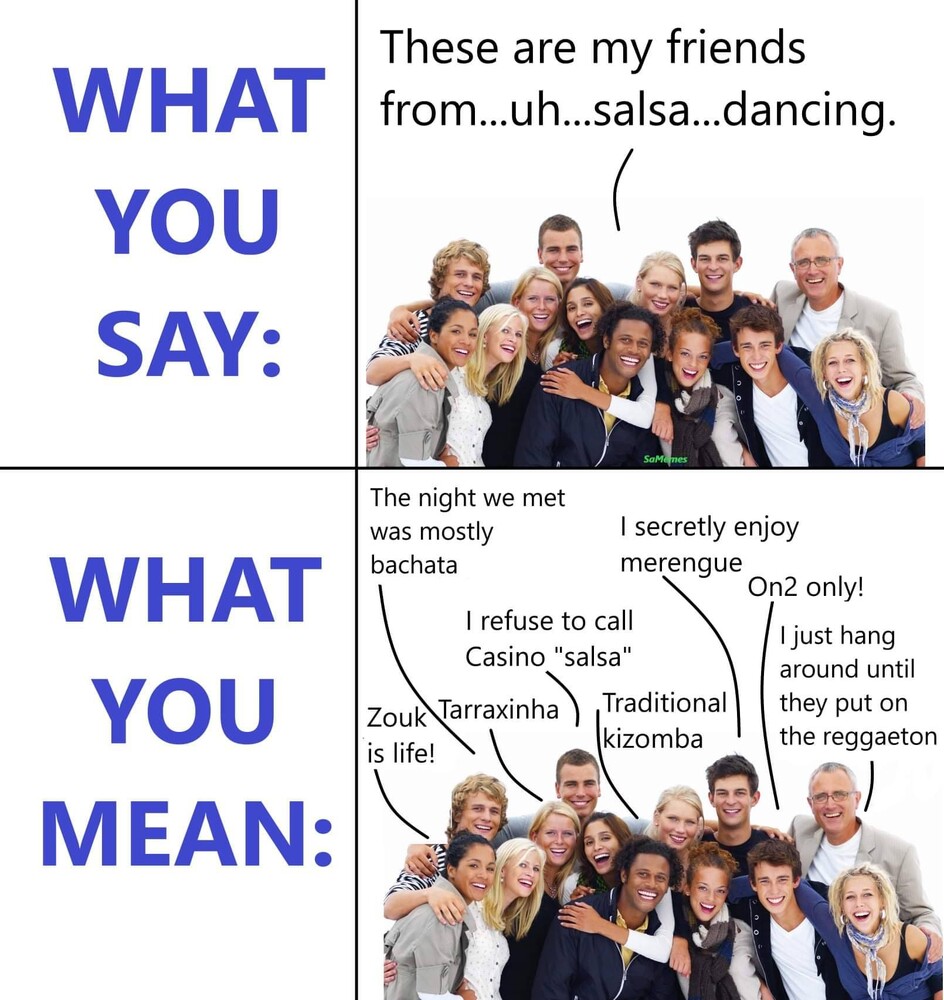
What some of us mean when we say "salsa" dancing
The Parallels
Without further ado. let's get to The Parallels.
Persistence
I didn't have the "dance comes easy" gene, so to be a comfortable salsa dancer, I had to be persistent at it.
Similarly, in my professional life, there are things I learn fast, things I don't learn fast, and in all cases, it's persistence that has made the difference.
Prioritization
I had to prioritize which dances I'd get better at. Outside of African dances that I'd do at parties, I decided to focus on salsa (initially "on 1" and later also "on 2"). When it comes to the Latin dances, there's also merengue, cha-cha, reggaeton, kizomba, zouk, and others some of which come easy and some of which do not. There's swing, waltz, tango, flamenco, and a ton of other dances. If I had tried to learn all of these at the same time, I probably would not be good at salsa now.
Similarly, in my professional life, I have a lot of things that I want to learn and be better at, and that list grows and changes. I cannot do it all though, so it's important to prioritize.
Confidence & Mistakes
At one time, early pictures of me had a frown when I made a mistake at salsa dancing. I once made a mistake during a performance and it was less noticeable than my reaction to the mistake, and that is forever in the video.
At the time, this was also how I internalized the mistakes in my professional life.
I've learned to have more confidence in both.
Now when I think I make a mistake on the salsa dance floor, I smile/laugh and apologize. Half the time, it wasn't even my mistake and the salsa lead lets me know that. And the times that it was my mistake, we can usually move on pretty quickly and enjoy the rest of the dance. (I have an article Regarding Sorry, and I still say 'Sorry' when I should say something else, but in a dance, we're moving so fast I often can't fully analyze.)
Also, at one time I waited for salsa leads to ask me to dance. But when that wasn't happening enough, instead of getting frustrated by it, I started asking. I got some no's, but I also got some yes's. Initially the "no"s affected my confidence but I got to the point where it didn't and I'd just keep asking people until I got a yes or until the song ended. And now if a salsa lead asks me to dance but is a beginning, I even have the confidence to help them lead me so I can properly follow.
Professionally, I'm more confident than I used to be but it's still something I work on, along with being kinder to myself when I make mistakes and recovering from them faster and effectively. The parallels are there, but both things definitely happened faster with salsa.
Testing your "cannot"s
Early in my salsa dancing journey, I saw someone dancing, and thought "Wow, I'll never be good enough to dance with him!". Fast forward, and that person is now my "brother from another mother" and one of my favorite dancers.
Even when I became a better dancer, when I auditioned for the salsa performance group, I didn't expect to be accepted, but I was. It was the "student performance group" (versus the "professional performance group"), but my non-dancing friends still are impressed and tell people that I go around the country doing salsa competitions.
In my professional life, there are things I knew I could do well. Previously that was coding, now that is being an engineering leader. There were also things that I never thought I would be good at. Public speaking and presentations come to mind, and these come more naturally to me than before. To be clear, I'm still going to feel nervous, but thankfully I haven't appeared to be nervous, and that's a win.
Get the "Lead"ers/Coaches/Mentors
On that note, it's also ok to get more help for your "cannot"s.
Most salsa venues in my area have group lessons before open dancing. I'm an intermediate salsa dancer because when I was a beginner, there were salsa leads who danced with me, were patient, helped out, and kept dancing with me. Even so, I briefly paid for private salsa lessons in addition to the group lessons offered by most venues.
Professionally, to get better at public speaking, I got a speaking coach (or more accurately, the startup I was in agreed to pay for the speaking coach to help with a competition I needed to present for, which I won, and have continued to speak since then). And in terms of engineering leadership, I engaged two career coaches in 2023 in addition to the mentoring I receive from various people.
Always be learning
When I was so comfortable dancing salsa (on 1) that I didn't have to think about it too much, many of my dancing friends switched to kizomba. I tried it and don't like it that much (but we're all different so yay to those who do). But I heard that you could dance zouk to kizomba songs. So, I started learning zouk. I still have more to learn, but I can do enough zouk (or kizomba if I must) to not sit out so many songs when I go to dance events.
Professionally, it's a good thing I believe in always learning, because in tech, things change and you must learn new things. I'm learning a lot right now from so many places, including SheTO.
Taking Breaks and Knowing When To
Professionally, I've been so bad at taking breaks during the day that I now have to schedule them into my calendar and have coworkers keep me accountable. Often, taking breaks helps you come back fresher to the task at hand and make it better.
This parallel definitely applies at salsa congresses (why we call our festivals 'congresses', I don't know). There are a lot of lessons, and it can be tempting to take so many that you tire early. So I learned to pace myself more, whether or not I am performing that night.
On the other hand, sometimes you shouldn't take a break. On a normal dance night I want to dance as much as possible for 2 hours. Lately it's been closer to 90 minutes and that's fine. When friends have bought me drinks, I appreciated the drink but also thought "I need to drink this quickly and get back to dancing!". If I stop dancing long enough, I might realize I'm tired and that it's time to go home, especially since typically it's 10 pm or later and I might have work the next day. So these times, I don't need or want a break. But I respect those who do.
Acceptance Of Others
Do I want all my friends to dance? I mean, I wouldn't be opposed to it. And we've succeeded in bringing a few to the "fun side".
But we're all different. Some like to dance, and some don't. Some will dance any dance as long as their body is moving, some have specific dances they will and won't dance.
Similarly, professionally, we're all different. And that's not just ok, it's fantastic. Accepting our differences can help us work better to build better products and services.
People have different needs
When I'm dancing, I want to move. I don't like to stand still. As I got to know the crowd better, I knew the salsa leads who I could point to and they'd gladly come take me out of my just-standing-there-misery, those who might want to dance but needed to sit out a few dances, those who could be convinced even if they were thinking of leaving, and those who would rather not dance at all but I could tease them about it, and those who would rather not dance and didn't want to be teased. (Many salsa spots are restaurants and bars so some people come to salsa night not to dance. Shocking, I know).
Similarly, professionally, there is no cookie-cutter approach to interacting with people, though there are definitely guidelines and best practices. It is important to get to know people and their preferences, and where possible find a middle ground that works for both. This applies to bosses, peers, directs, other teams, and probably all your coworkers.
Asking for what I want
This is something I'm still working on professionally. My leadership style defaults to "servant leadership" and it's easier for me to ask for what others need/want.
I took this lesson of asking for what I want to the dance floor this weekend. I prefer to dance "on 1" but am usually happy to also dance "on 2" as long as the salsa lead is patient with me, so I usually tell the salsa lead that and leave it up to them to decide. But this weekend, I was feeling rusty (feelings are not facts!). Plus after a dance or two I realized I was drafting this blog in my head. So I really preferred to dance "on 1" all night and when I was asked, said "On 1 please" all night. But because of the always be learning thing, I will continue to dance "on 2" to get more comfortable with that sometimes.
Adjusting with changing times
My favorite salsa spot closed 5 years ago. I loved going there so much that I didn't care that it was on Monday nights, open dancing started at 9 pm and was a half hour commute each way.
Now, it is harder for me to start dancing after 9 pm. There's a different Monday night spot some of my friends go (including my "brother from another mother"), but dancing there starts closer to 9:30 or 10 so I barely go. Now, I need to find spots that don't keep me out too late. These spots usually don't have as many familiar faces, which is odd when you've been dancing in this area for more than a decade, but as I go to them and continue some of the lessons in this blog, they will hopefully become more comfortable and more familiar.
Professionally, the only constant is change, and I think most professionals are going through that in one way or another. Adjust, we must.
Conclusion / What Next
Salsa-wise, I'm going to continue to dance and enjoy it. It's ok if I am always at the intermediate level. And if I can find a way to fit rehearsals into my schedule, I would love to perform again. And no, I still don't need a break on the dance floor, so if you see me standing still, I'm looking for someone to dance with, and you can ask.
Professionally, I'm going to continue to learn, and share more in speaking engagements, blog posts, podcast appearances, etc.