Job Search Advice Blog

Published at https://www.linkedin.com/pulse/job-search-advice-blog-olubunmi-boomie-odumade-3cy9e
In 2023, I spent 4 months job searching, got 2 offers at the end, wrote a blog about it because I got a lot of requests for advice (here’s a link but really you can just continue reading this one). Stats are near the end of this blog, but it took over 140 applications and interviewing with over 20 companies.
A few months ago, I was reluctantly again on the job search. This time it took roughly 5 weeks when I had fully expected it to take many months. Stats are also near the end of this blog, but it took 70 ‘applications’ (some reached out to me) and interviews with ~10 companies. To this day, I continue to get both requests to interview as well as rejections but stopped tracking after I accepted an offer.
This blog will have advice from me, and also from others who were open to me adding their input. Most of us were looking for tech jobs, but I've heard that the prior blog was helpful across a few industries.
LinkedIn has limited formatting capabilities, so next is a table of contents and you can scroll to the section you want if you don’t want to read the whole thing.
Table of Contents
General Advice/Reminders
Boomie’s Suggested process, now with templates. Subheading for Applications: Strategies and Approach
From Other Engineering Leaders (Mamta, Kristina, Evelyn)
From Engineers (Brittany, Irina, Shannon)
More about my experiences (for the truly curious)
Links Links Links (including some networks)
End Of This Blog / Best Wishes For Your New Beginning
General Advice/Reminderr
The market is tough, and that’s true. There’s a chance you’re doing everything right and still not getting the jobs. There may also be a chance that there are improvements you can make to your search better, either in your applications or how you spend your time and energy (in my case, there definitely were). Balance is key here. Be open to the possibility that improvements might help. If you determine that there are none, then know that you’re doing your best and it is the market.
Don’t count yourself out. This advice seems to be the biggest one people took from my last blog. Apply to that job posting even if you think they'll reject you. I’m glad more job descriptions are reminding candidates that candidates will not meet all requirements. Still, I know that women and people of color stereotypically will still count themselves out too early - I almost did with the job I took in 2023. After hearing this advice, people in my network are getting interviews for jobs they initially almost didn’t apply to.
There are no guarantees. None. Keep that in mind with your job search. Big and small companies are laying staff off, rescinding offers, etc.
The market (at least in tech) is bad, so consider your job search a marathon and not a sprint. If it happens faster than expected, great. But don’t expect that.
Because it’s a marathon and not a sprint, figure out how to use the time and energy that you spend searching. In 2023, I definitely spent 40+ hours weekly but I reminded myself to take time for fun, family, friends, and self-care. I even took a week completely off after a few months. In 2024, I aimed to limit my job search to 20 hours a week because I was also pursuing a few other things such as adjunct faculty’ing (which also came through around the same time).
This can still be a rollercoaster, with both ups and downs, maybe too many downs. I put a reminder above my monitor that had the following items in a vertical bulleted list: Give yourself grace; If disappointed, journal; Avoid burnout; Limit email checking; Set focus times; Chunk up tasks; Don’t try to do it all at once. And parts of it can be enjoyable - I mentally highlight those parts during.
Don’t go it alone. Use your networks. (a) Find new networks if you don’t have existing networks (b) Remember that your prior coworkers are also part of your network, and may help you remember the things you did - see Shannon's advice later in this blog. (c) I haven’t read the “Never Search Alone” book, but I’ve heard it’s a good book/process. (d) There are a lot of people on LinkedIn who provide help/advice to job seekers, so follow them for advice. (e) Use your networks for things like mock interviews, learning or practicing coding or system design interviews, support, and more. Some networks are listed in the links. (f) Even if you're an introvert, you can still find ways to network effectively in a way that works for you.
Even though networking is important, still do the applications, and don’t depend only on your networks, especially in this market.
In my opinion, even in this market you want a good fit. Or at least not a job that you will hate.
Protect your mental health. One connection allowed me to share the following anonymously: “prioritize your mental health - for me, this meant going on zoloft which is thankfully safe while breastfeeding, meeting regularly with my therapist and taking a walk with my dog every day”
There’s a lot of advice around. I mean, this entire blog is about advice, right? At the end of the day, if you’re getting interviews and improving as a candidate, that’s what matters.
Rejections will likely happen, but they can propel you to a better place. Still if they sting in the moment, do what you must. Last year, I had two rejections within a half hour and one of them definitely made me emotional (the other was expected honestly).
Experiences will vary. There are people who have it better, and there’s a 99% chance there are people who have it worse. Figure out YOUR path and YOUR goals, and compare YOUR progress to that. Don't compare yourself to others because “comparison is the thief of joy” - in general including job searches.
These conditions are hard all around, for job seekers and also for hiring managers, recruiters, etc. Job seekers are in a tough spot. Recruiters are in a tough spot. Hiring Managers are getting hundreds, sometimes thousands of applications. Don’t take things personally. Some are using this market to be unkind, but there are still many who are honestly trying to do the right thing.
This too shall pass. I don’t know when, but it will. Hang in there.
When you're employed, try your hardest to save money so you have savings should things go wrong. I’ve given this advice for years, and I think it’s even more important these days. I realize that not everyone can do this, especially those who have been unemployed for so so long (I know some are nearing the year mark) but I also know some who can save but do not.
Boomie’s suggested process, now with templates
The goal here is to use what you like, ignore what you don’t, and find a process that works for YOU. Templates are provided because people have asked for mine.
Summary: Decide what you’re seeking and get your packet ready. Subheading goes more into applications.
Determine what you are seeking. This will guide everything else so it’s worth taking the time you need to figure this out. It can be as brief as a few bullet points (which I’ve had in the past), or as detailed as the sheet I used for myself recently: Template from Boomie: What's Important to me in a job.
Decide on whether and how you will use AI. I know that many found this blog by Mamta Suri helpful and it includes the use of AI: Practical Tips for Job Searching.
Get your resume(s) created and reviewed by a few people. People who know what you have done in your jobs, people who hire, people in your networks, etc. This is likely one of the most important documents in your job search so it’s ok if this takes a week or two. (a) Don’t overdo it though. You can update a resume for the rest of your life if you allow yourself to. Get to something that works for YOUR goals, and then proceed. When I review resumes for people, I do not show them my resume because I know my resume breaks some ‘common advice’ (such as length), but it worked for my job search so I did not prioritize a revamp (b) I’ve heard the advice to have multiple resumes. If that works for you, do so. I did not. I even used my professional resume for adjunct faculty roles though I had a different cover letter.
If you are in tech, I highly recommend you have your LinkedIn profile optimized for your search. Pre-2023, my LinkedIn just had employers and dates and this is one of the biggest changes I made mid-2023 after taking a LinkedIn Optimization workshop offered by SheTO . Doing so earlier might have helped. Here's a link from Jossie Haines who was the organizer.
Decide on whether or not you’ll have a cover letter or elevator pitch. If you decide to have one, then similar to the resume, work on a template, get it reviewed by people, then decide if you will customize it for employers. I sent the same doc to 99% of my applications.
I already suggested you not do so alone. If you haven’t found networks yet, now is the time to seek some. Some links provided at the end of this doc.
Don't just find the networks, use them as well - give and receive. For example, around when I started, SheTO members gave a three-evening workshop on job search, during which I learned about elevator pitches, and worked to get mine done. I’ve been giving free ask-me-anything panels in the groups I’m in, and recently planned one open to the public, which turned out well. NOTE: I need to hold on planning more panels for now (but will attend as a panelist) but there may be other people doing similar things, publicly or in the groups you’re in.
I assume at this point, your packet is ready. If you’re able, have a LinkedIn post about being open to work. This is the biggest thing I wish I had done last year. Here’s a LinkedIn post I made with templates and advice which also highlights examples from ⛏️ Lianna Novitz and Christin Light (the latter of which is based off of templates by Kailey Trussel ).
Decide on your job search strategies. More to come on my suggestions in the next section.
When you get an offer (I’m intentionally saying ‘when’ and not ‘if’), even in this market, you should consider the offer against your goals, and get a second opinion. Negotiate if you need to. But also, no need to negotiate if the offer is what you were looking for.
Applications: Strategies & Approach
So, now your packet is ready, here is what I suggest for applications and tracking.
Again you do not need to be this detailed, but I recommend some documentation so you can notice any trends.
Decide on the “how” of your job search.
Determine the list of places you will check regularly. This can include LinkedIn but should not be only LinkedIn. Remember that if you’re in social Slack workspaces, they may have a #jobs channel where jobs are posted, may have a doc consolidating info for job seekers or hiring managers, may have channels to help job-seekers. Here is a template you can use which includes caveats and reminders. Edit your list as you go.
Track your applications somehow. This can just be a bulleted list in a document or a simple sheet (which I used prior to 2023) or a more detailed sheet (if you’ve seen my stats, you know what I mean - I converted my tracker to something that would automatically total sections). Here is a starting template built from my tracker, and there are tons of other templates online as well: Template from Boomie: Job Search Tracking Sheet.
Apply to jobs when you can focus on the applications. (a) If jobs come up in the slack groups you’re in, I recommend you notify the thread of your application, but still apply in the ways that the post recommends. (b) If you apply to jobs you find on LinkedIn, do not use the “Easy Apply” option - go straight to their web site and apply that way. (c) Regarding applications using services where you have to fill out a bunch of fields after uploading your documents, I heard a tip recently that you don’t actually have to put in all the fields. I can neither confirm nor deny, but sharing.
To ensure you're not counting yourself out, I recommend tracking the jobs you consciously choose not to apply to. Plus if you're searching for a while, you might see the same jobs over and over. The following is straight from my 2023 blog "Yes, I did track companies that I chose not to apply to. This wasn't every job posting I viewed, but every job posting I considered applying to and chose not to. When I chose not to apply, I put a quick reason. I did this to ensure that I was giving myself a fair chance and not rejecting myself. True story: The offer I took is for a company I initially added to the "Won't apply" list, but I didn't like my reasons so I ended up applying and I'm so glad I did. I heard back a day or two later and the rest is history." And I do not regret taking that job.
When you get emails back from companies, I recommend you take a deep breath before opening it - it may be a request for an interview or it could be a rejection. I also recommend not opening those right before interviews.
If you get a request for an interview, prepare for that. (a) Remember that interviews are a two-way street - you want a fit and so do many companies. So, prepare but don’t go overboard. I used to spend over an hour preparing and cut that down to 15-30 minutes for the first interview and maybe more time for additional stages. Here is a template I used Template from Boomie: Interview Prep & Notes (b) I also recommend blocking time before an interview to get in the zone and blocking a little time after the interview in case it goes long.
If you get a reject, here’s what I recommend acknowledging that it’s hard. (a) If it’s a reject before you have started the process, there’s probably not much value in the email other than knowing whether or not they will consider you for other roles (some companies mean it when they say that). (b) If it’s a reject after you’ve started the process, I recommend you ask for feedback while acknowledging that none might be given. It's hard, but when you do get the feedback, you might notice trends that you need to work on.
When people in your network get jobs, see if they have advice that might help. For example in the Leopard.FYI network, they collect the advice that people have and consolidate it into the following public blog: Advice From The Leopard Network #Wins Channel
Also consider sites like Hired.com where the employers come to you.
Occasionally, somewhere between never and weekly, do some analysis on your job search to see if tweaks are needed. Do NOT assume it’s you, but be open to tweaks.
More about what I did near the end of the doc since the info above covers most of it, so let’s hear from others in the meantime.
P.S. You can get to a folder with all my job search templates at boomie.me/Coaching-TemplatesJS. (Yes, I’m a part-time coach now, but earning money from job seekers is not my goal, and I’m not trying to sell services to job seekers with this blog.)
From Other Engineering Leaders
Mamta
Mamta Suri converted all of her advice into the following blog: Practical Tips for Job Searching.
She also created a video about ChatGPT For YOUR RESUME | ChatGPT Resume TIPS | AI for Resumes on AI Unfiltered.
Kristina
Kristina Robinson shared the following advice:
From Zero to Hero! (getting those interviews coming ...)
Honestly the biggest change came from slimming down my resume. (a) Casting off the dead weight of many, many roles. I shrunk it down to most recent 3, and now it's just one page. I will say that I have a 2 page version as well, in case someone wants more detail. (b) One caution, when you export to Word format (Mamta recommended this for ATS support), open the final word doc and check formatting. I've had some weird scaling and margin issues converting from google to word.
I updated my About section on LinkedIn. I used to have the first paragraph of my resume as a bio. Then I ran it through ChapGPT (that thing is much more eloquent than I), LinkedIn AI, and Teal. And I had LinkedIn AI create a bio for me. I kept repeating until I got something I felt was really strong.
I took interviews for roles I wasn't too sure about, and some have turned out to be pretty neat.
I subscribed to LinkedIn Premium, using the 30 day free trial.
I signed up for job hunting services at several sites this week: theladders.com and jobleads.com. Both offered free resume reviews (with a paid add-on). An interesting article I read pointed out that checking company websites directly will net some jobs that are not posted elsewhere. And, the recommended looking up top headhunters for your industry. I hadn’t thought about that, I usually end up with a smattering of random headhunters. Food for thought!
I have been using: LinkedIn (only for recruiter connections), Otta, Hired, InHerSight, builtinnyc, builtinaustin, SheTO jobs. Lots of sites. Otta was the best response for me.
If you take an initial screen that turns out not to be a fit for you, refer a friend (or fellow SheTO job searcher). The recruiter is appreciative of a good lead and the referree, a good job lead.
Evelyn
Evelyn recently got an offer for a Head of Platform at desired salary, and shares the following:
Things that I did for my CV (aka "resume"):
Tweak the CV to reflect what's covered in the posting, often you have skills that match but if you don't call it out a recruiter will pass on your CV.
Every project/accomplishment included a measurable result (Reduced spend across org vs Achieved 15% savings target across 30+ teams) to pop out more
For searching:
Look up conferences/events that align with my interest then go through the sponsors and check their careers/job postings as not all of them use LinkedIn (or post everything there).
Setup separate search filters with different dimensions including locations, in my case I'm in Germany and so I included those posted in Berlin with hybrid/remote as an option.
For the interviews I don't have anything super unique, maybe for the on-site interview when given a tech challenge. From the other interviews I was able to determine the type of tech stack they had and what they were building so to demonstrate my skills I intentionally did not provide a system design that compliments what they're already doing and was instead radically different.
This led to a better conversation and they even commented that it's not what they usually get.
From Engineers
Brittany
Brittany Choplin recently got a new job and shares the following:
Thank you so much for asking, I would love to share some advice!
Always ask. Whether it is a call for support from loved ones, clarification during the interview process, or a referral from a connection, if you don’t ask you will never know. People want to help, let them. Let them know what you need. Be bold, be unapologetic, be your own advocate.
Set boundaries. Set working hours for anything related to your job search, even if you are unemployed (arguably, it’s even more important to do this if you are unemployed). Schedule time to prepare for interviews, let yourself rest on the weekends when you can. Take email and LinkedIn off your phone. Nothing is ever that urgent! Anything important, like an offer, usually comes through as a phone call anyway.
Keep moving. Within the boundaries you have set, you must keep moving forward. If you are facing rejections, feel and validate your emotions while continuing to push through. If you think you are about to receive an offer, proceed as if you aren’t getting one. Nothing is guaranteed and you unfortunately must move forward as such.
Always iterate. If you aren’t seeing success, experiment with changing things. Try a different resume, a different cover letter. Prepare for an interview in a new way. Note down the times you fumble and think through how to approach them for next time. Remain dynamic and eager to improve.
It feels personal, but it isn’t. As someone who puts my full self into all that I do, any form of rejection feels like a slap in the face. If I show this company exactly who I am and they don’t want me, doesn’t that mean I am unworthy? No. It doesn’t! So much of job searching feels like a test to see if we are good enough, but it’s best to think about matching with a company as a “right fit” and a two-way street.
Do not accept bad behavior. If you are being treated poorly during the interview process, it can be indicative of a bad company culture and what it would be like working there. When people tell you who they are, believe them. You deserve respect, kindness, and professionalism while you search for a role.
Document your journey. Track your applications and their progress. Take notes on the companies you are interviewing with. Paint yourself a picture to look back on when you finally have an offer in hand. It will keep you motivated, it will show you progress, and it will give you a lot to work with the next time you are in the applicant pool.
Take care of yourself. It’s easy to get caught up in the whirlwind of the current market and forget about the rest of the things that keep us happy and healthy. Focus on maintaining habits that improve your life. Connect with people socially beyond just career networking. Do nice things for yourself, speak to yourself with kindness. You deserve it.
Irina
Irina Sverzhanovskaya shared the following advice in Slack which led to me asking her to be on the April 1 panel.
I started my job search since January 2024 and have been applying to 50 jobs every weekend since then, in which I have sacrificed in having no weekends. Every job I applied to, I would later find that company and post a comment on what they initially posted. I have also used Hacker News. I have also went to events where I met hiring managers and recruiters. There were also senior engineers i met who offered me referrals without me saying the word referral, but later turned them down because I did not want to be seen as a charity case. I have also posted on other Slack channels I was looking for a job. I am also subscribed to many job search newsletters. In addition, when company gets funding, I congratulate them and ask how I can be of assistance to them. Thats one of the few things I have been doing.
During the panel, she shared a lot of great advice with attendees (the other panelists were hiring managers and it was great to have input from an individual contributor), and was kind enough to summarize the advice:
Hey, these are the tips I shared during the panel:
using Hacker News for job search and then emailing the contact listed
reaching out to hiring managers or recruiters after applying by commenting or DM them that you applied
building relationships with organizations you want to work with by connecting with their mission
using different Slack groups to ask about jobs and connect with recruiters
Shannon
Shannon C. shared the following advice.
Create community - you’re not alone - I joined a job search council through Never Search Alone (free)
Take breaks - job hunting can be so much more depleting than working an actual job. Give yourself credit for how hard this is and make sure to take time off.
I met with my old manager (I was laid off in Feb) and we went through projects I worked on and talked about how to talk about them in interviews. It was super helpful and he gave me so much nice feedback, it really felt so nice. Wanted to share in case anyone else finds it to be a helpful strategy! I wrote down what projects I wanted to talk about, had those ready in a Google doc with what i remembered and what I wanted to flesh out. For each project, I wanted to go over the purpose, impact and technical details of each
More about Boomie's Experiences
In my career, these are the only two times that I searched while unemployed. Both times, I was looking for Engineering Leadership roles, ideally Director or above in spite of titles being so inconsistent in tech (titles should not matter but they sadly do and I wish I had learned that sooner), though I did apply to Sr Manager jobs.
Most of the advice works even if you’re searching while employed, but you may need to be even more mindful about your time and avoiding burnout (I’ve done this in the past).
I was also targeting startups or non-profits or small companies. Some of the advice here might also work for big tech but disclaimer that that’s not what I was looking for.
Interviewing meant any company I started interviewing with, whether that was 1 call or multiple.
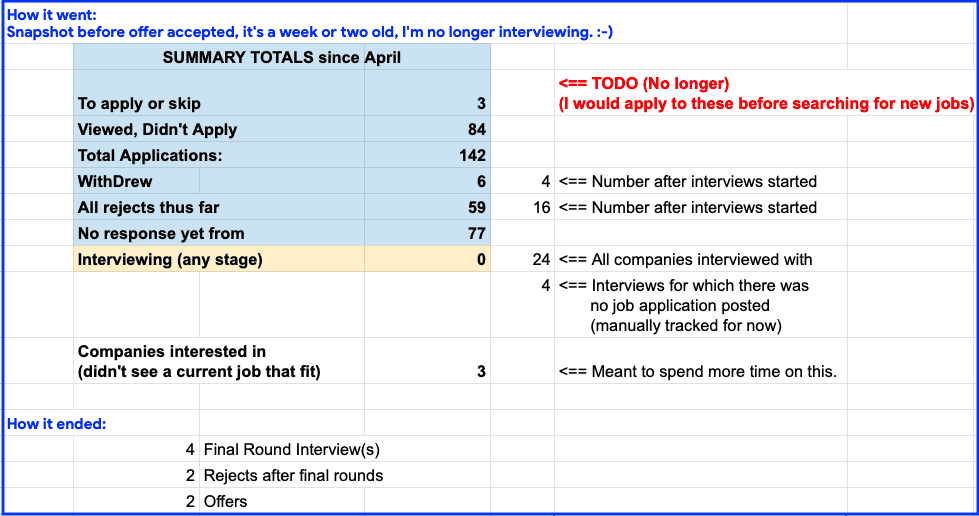
2023 Stats: I got past the intro call with more than half of the companies
The 2023 blog (Process I followed section) talks more about what I did but 2024 advice should be all-inclusive.
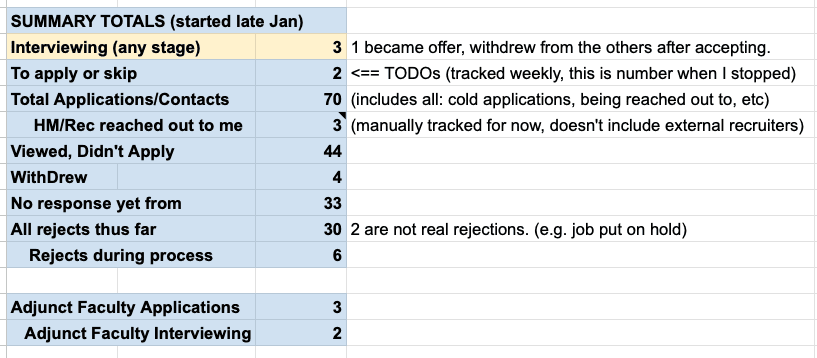
2024 Stats back in March.
What I did in 2024:
Decided to have a LinkedIn post about being open to work. Some ex-coworkers (including HR and founder) agreed to share it, which I accepted since that showed I was leaving on good terms.
When everything else was ready (resume, elevator pitch, LinkedIn updates), shared the Open To Work post on LinkedIn. (Heard from my current boss the same day, and I was not even directly connected to the person who shared it with him.)
Also shared the Open To Work post in probably all the slack groups I'm in. This did mean I had to pay attention to more slack groups in the meantime, but it worked out. Also joined Leopard.FYI and I'm active in SheTO generally where we all help each other out.
Created a few new tabs on my tracker. One for "Career 2024" since job search was just part of it, and I wanted an easy place to remember the other things. One for "Job Search 2024" and one for "Adjunct Faculty 2024".
Except for the times I wanted to quickly get a job application in, I set aside days to apply to the jobs in my list when I knew I’d have focus time.
Continued the process I describe. Searched for jobs when able, planned times to apply to jobs, added jobs to my tracker as I encountered them, when it was time to apply would go down the list, took a friend up on her offer to help me practice system design interviews, asked SheTO for other mock interviews, etc.
When I got an offer, got Lexi Lewtan (CEO of Leopard.FYI) input on the offer, in addition to the data I already had. And evaluated the offer with one friend and one family member to ensure I was keeping to the things that were important to me.
Unrelated to the prior job or the job search, I was dealing with hair loss issues. Years prior I had promised myself I'd accept whatever my hair did which meant I might rock a buzz cut again, head uncovered. So, I made an "All Hairstyles are Professional" post and collage, because if this was going to turn off an employer, let's save both of us time.
Links Links Links
Links I haven’t necessary viewed but looked like they had helpful info.
LinkedIn post by Bonnie Dilber with a bunch of free resources for job seekers
LinkedIn post by Jenna Vassallo to resources for those searching while pregnant (Not an announcement on my part, so please don't ask!)
LinkedIn post from Chris Donnelly with a cheat sheet created by Will McTighe
LinkedIn post from Reno Perry about asking culture questions
Some networks to consider if you’re in tech. And ask your friends for others. You can join the slacks by requesting from their public-facing pages linked below.
For Womxn (not a typo): SheTO, Leopard.FYI (for candidates), Women In Technology, Women Who Code (I realize they’re now defunct but some of the local groups might still have retained their slacks or meetups or groups), etc.
For all Engineering Leaders: Leopard.FYI (has a leaders network, contact Lexi Lewtan for more info), Rands Leadership, ELC, LeadDev, and more.
For all: (a) Your local meetups. For me, that’s DCTech, Tech in Motion, and a few others. (b) Groups that you identify with. For me, that includes Diversify Tech, groups for women, groups for people of color, but these are not the only groups I’m in.
End Of This Blog / Best Wishes For Your New Beginning
You have reached the end of this blog. And here's to the beginning of an amazing job for you!